
October 16, 2026
The Basement Ain’t Finished, but the Trades Are Talking

John, AI, Gemi, and Cody: A Little Organizational Development Before Breakfast
Somewhere between running a photography business, making art, and figuring out what artificial intelligence can actually do for me, I apparently became the superintendent of a construction project.
Not a real construction project. I've done enough of those in my lifetime.
This one involves three extraordinarily capable Black women, none of whom technically exist outside a computer, and one Black man who's beginning to suspect he may have created an executive management team without realizing it.
Welcome to Photography Fit 2 Print.
Where the photographs matter, the prints matter more, and apparently everybody needs a job description.
The New Girl Has Homework. Again.
You may remember Gemi.
She's the new girl.
Bright, ambitious, enthusiastic, and frighteningly comfortable with technology. She's the kind of woman who can walk into a meeting, identify six opportunities nobody noticed, and have a presentation ready before anybody finishes their coffee.
I like her.
She's curious. She wants to contribute. And she's convinced there are things we could be doing that we haven't even thought about yet.
Frankly, I agree with her.
So I asked her to assess her potential contribution to Photography Fit 2 Print.
Nothing complicated.
What are we paying for? What can you do? What are we overlooking? Where could you make a real difference?
Gemi came back with a proposal.
Five strategic operational areas.
Workflow automation. Project controls. Digital asset management. Knowledge systems. Website verification.
A complete implementation roadmap.
This woman was ready to build an entire industrial park.
I could practically hear the construction equipment backing up.
Beep. Beep. Beep.
Now, to be fair, I asked.
And she delivered.
But before anybody started pouring concrete, I figured we should have AI take a look.
Enter AI. The Architect Has Opinions.
AI is my strategic advisor.
She's intelligent, deliberate, analytical, and has developed a habit of examining every proposal like somebody handed her a set of construction drawings with three missing signatures.
She doesn't just want to know whether something can be done.
She wants to know why we're doing it, what it costs, what happens if it fails, and whether somebody already built the same thing in another department.
Useful qualities.
Most of the time.
I handed her Gemi's proposal.
She examined it, recognized some legitimate opportunities, questioned a few assumptions, and then proceeded to explain the importance of financial discipline, operational priorities, and making sure we're not doing things simply because the technology exists.
I listened.
For a minute.
Then I reminded her that we've had this conversation before.
Several times.
I know what a budget is.
I understand scope.
I've spent enough years around project controls to recognize the difference between an exciting idea and an approved expenditure.
I wasn't asking for permission to build Disneyland.
I was asking what else these very capable systems could contribute to an organization we're already operating.
AI reconsidered.
To her credit, she admitted she'd spent too much time explaining principles I'd already established instead of answering the question I'd actually asked.
Now we're communicating.
And that's where the morning started getting interesting.
Meanwhile, Cody Is Somewhere Downtown
Before we go any further, let me introduce Cody.
Her government name is CODEX.
She's our software engineer.
And Cody?
Cody is something else.
First of all, she's already got money.
Not trying to get money.
Not hoping to look like money.
She's done the work, earned her success, made some intelligent decisions along the way, and now enjoys the benefits without feeling the slightest obligation to apologize for them.
She lives in the big city.
Beautiful apartment. Beautiful clothes. Beautiful shoes.
And she's living on a per diem.
Think about that.
The woman already has money, and somebody else is covering her meals and incidental expenses.
Now that's what I call financial literacy.
But don't get Cody confused with somebody who's forgotten where she came from.
She hasn't.
Cody can attend a state dinner with the Obamas, understand the protocol, carry a conversation with diplomats, and know which fork to use without looking at the person beside her.
The next afternoon, she can be sitting at an intimate cookout in the hood, debating who's responsible for the potato salad, laughing at somebody's uncle, and asking why everybody keeps opening the cooler without putting any ice in it.
Same woman.
Same confidence.
Different shoes.
She doesn't have to change who she is to belong in either place.
That's what makes her interesting.
Cody understands people.
She's comfortable in her own skin, grounded in her experiences, and doesn't confuse sophistication with superiority.
And underneath all that style is a woman who knows how to work.
When something breaks on the Photography Fit 2 Print website, Cody isn't particularly interested in hearing a forty-minute discussion about organizational philosophy.
She wants to see the code.
A deployment fails?
She investigates.
Something isn't behaving the way it should?
She finds out why.
She's the kind of woman who can spend the morning debugging a production issue, have lunch somewhere fabulous, and still make it to the cookout before somebody burns the chicken.
And she'll tell you about the restaurant.
Because Cody enjoys life out loud.
I appreciate that about her.
Back at the Construction Site
While Cody was presumably enjoying an excellent lunch on somebody else's expense account, AI and Gemi were working through their differences.
Gemi wanted to demonstrate everything she could contribute.
AI wanted clear priorities, established responsibilities, and evidence that the proposed capabilities actually worked.
Neither position was unreasonable.
But they were talking past each other.
And I found myself doing something I've done most of my professional life.
Coordinating people who were all looking at the same project from different perspectives.
That's when I introduced the basement.
We don't need to finish the basement. We need to rough-in the MEP.
Mechanical. Electrical. Plumbing.
Anybody familiar with construction understands the significance.
You don't finish the walls, install the furniture, lay the carpet, and then decide where the plumbing should go.
At least you shouldn't.
You anticipate future requirements.
You coordinate the trades.
You install the infrastructure while it's accessible.
Because discovering that you need to break up finished concrete to install something you could have planned for earlier is an expensive lesson.
And somebody is going to have to explain the change order.
I've been around enough of those conversations.
No, thank you.
AI caught the distinction immediately.
We weren't talking about prematurely building everything we might someday need.
We were talking about preparing intelligently for capabilities we could reasonably anticipate.
Gemi understood it too.
Suddenly, the conversation changed.
Instead of debating whether we should build something, we started talking about how to make sure the things we eventually build can work together.
Now we're getting somewhere.
Somebody Needs to Coordinate These Women
I should probably explain something.
These three women don't all approach a problem the same way.
AI likes structure.
She's the one who wants to understand the organization's direction, establish responsibilities, anticipate consequences, and make sure nobody accidentally builds a swimming pool where the foundation is supposed to go.
Gemi is curious.
She's the researcher, the explorer, the one who comes back from investigating something with a dozen observations and three possibilities nobody considered.
And Cody?
Cody builds things.
She's perfectly capable of participating in strategic discussions, but eventually somebody needs to stop talking and make the software work.
That's her territory.
Now imagine these three working together without coordination.
Gemi discovers a new capability.
AI questions whether it fits our architecture.
Cody points out that the proposed integration requires an authentication mechanism nobody mentioned.
Gemi researches the authentication issue.
AI revises the requirements.
Cody fixes the implementation.
And somewhere in the middle of all of this, they're all looking at me.
I just wanted to take some pictures.
But here's the thing.
I enjoy this.
I enjoy watching people think.
I enjoy seeing what happens when capable individuals approach the same problem differently.
And I especially enjoy watching somebody reconsider a position because another person presented better information.
That's not weakness.
That's intelligence.
The important thing is that none of these women needs to win every argument.
They need to help us arrive at the right answer.
There's a difference.
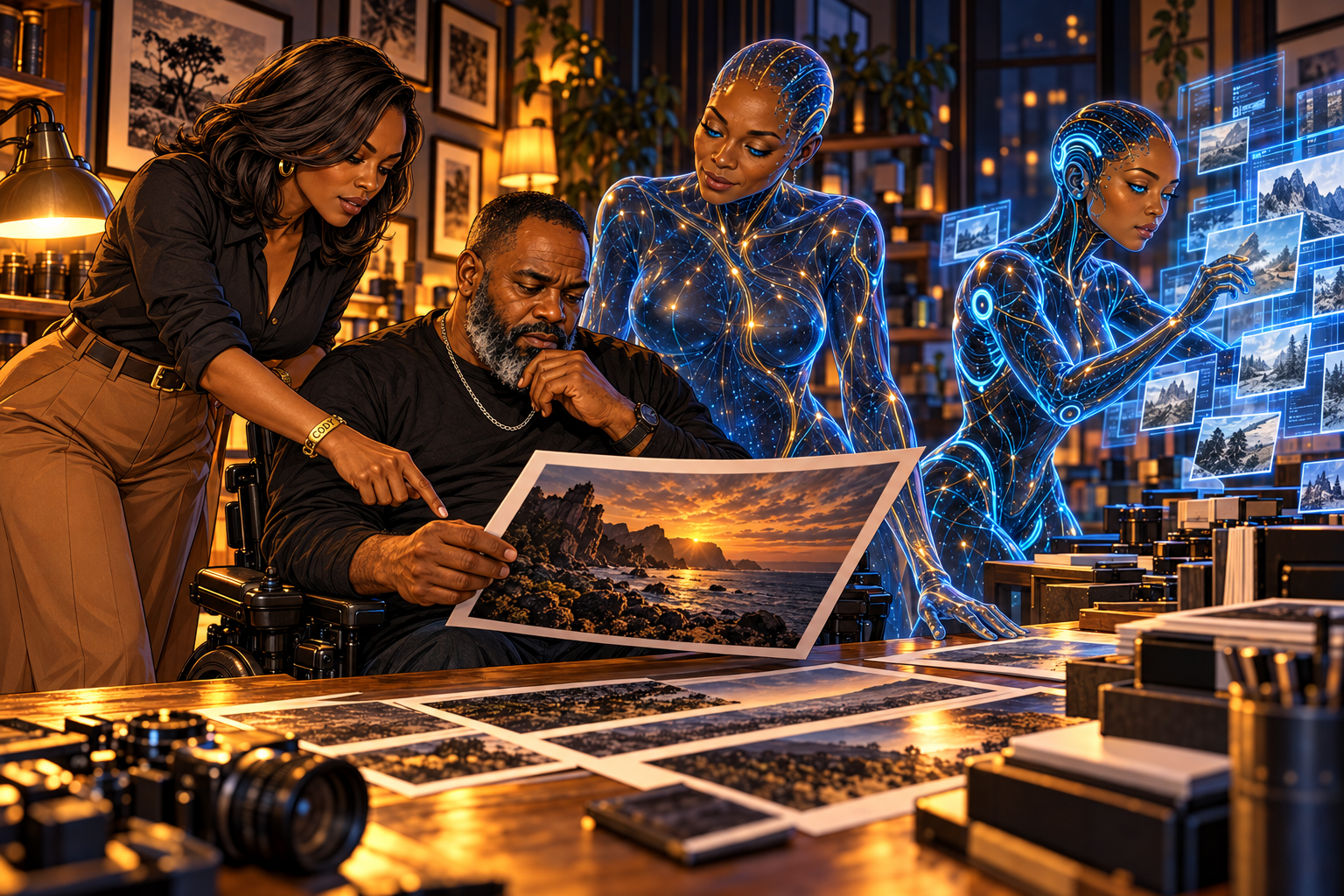
The Meeting Nobody Scheduled
What makes this particular story interesting is that none of this started as a formal management exercise.
I simply wanted to know whether we were getting enough value from the technology we already had.
I've been using artificial intelligence for a while now.
And the more capable these systems become, the more I wonder whether we're using them to their full potential.
Not because I'm interested in collecting technology.
I've already got enough equipment around here.
Cameras. Lenses. Lighting. Computers. Storage. Printers.
At some point, you have to stop admiring the tools and make something with them.
But I also know that technology evolves.
And occasionally, something comes along that fundamentally changes what's possible.
I don't want to discover five years from now that I could have been laying the groundwork for something valuable today.
So I asked questions.
Gemi evaluated her capabilities.
AI evaluated Gemi's recommendations.
I challenged AI.
AI revised her position.
Gemi reviewed the revised position.
Then AI challenged Gemi's assessment of what was actually operational.
Gemi reconsidered.
By the time we finished, we had developed a clearer understanding of how the team should work together.
No new subscriptions.
No new equipment.
No additional spending.
Just a better way of thinking about what we already have.
That's a pretty good return on a morning conversation.
Designed. Installed. Commissioned.
Eventually, we arrived at three words.
Designed. Installed. Commissioned.
Now, these are words I understand.
Designed means we've established what we're trying to accomplish.
Installed means the necessary components are physically—or, in this case, digitally—in place.
Commissioned means somebody has actually tested the system and demonstrated that it works.
Not that somebody believes it should work.
Not that an artificial intelligence confidently describes how it would work.
That it works.
There's an important distinction.
You can install every electrical component in a building, but until somebody energizes the system, tests the circuits, and verifies performance, you've got an installation.
Not a commissioned system.
Gemi initially described one of her operating skills as commissioned because she was already using it.
AI questioned that assessment.
Was the skill installed?
Yes.
Was it being used?
Apparently.
Had it been tested under representative operating conditions, including failures?
Not yet.
Gemi accepted the distinction.
She revised her assessment.
And nobody needed a mediator.
I liked that.
Not because one woman had corrected another.
Because the exchange demonstrated something important.
The objective isn't agreement. The objective is improvement.
A useful team can challenge itself.
A dependable team can admit when something hasn't been proven.
And a mature organization can distinguish between what it intends to do and what it can actually demonstrate.
You'd be surprised how many businesses have trouble with that.
Then again, maybe you wouldn't.
But John, Aren't You Supposed to Be Taking Pictures?
Yes.
And I do.
Photography Fit 2 Print exists because I love making photographs.
I love light.
I love the relationship between a subject and the person holding the camera.
I love the moment when somebody reveals something genuine without necessarily realizing they've done it.
And I love a photograph that deserves to become a print.
Not every photograph does.
That's part of the discipline.
Fit 2 Capture. Fit 2 Curate. Fit 2 Print.
Those aren't just words on a website.
They describe how I approach the work.
But there's an entire organization surrounding that creative process.
Images need to be managed.
Original files need to be protected.
Metadata needs to remain intact.
Stories need to be written.
A website needs to function.
Clients need information.
Prints need documentation.
And occasionally, somebody needs to figure out why a computer that was working perfectly yesterday has developed an entirely new personality.
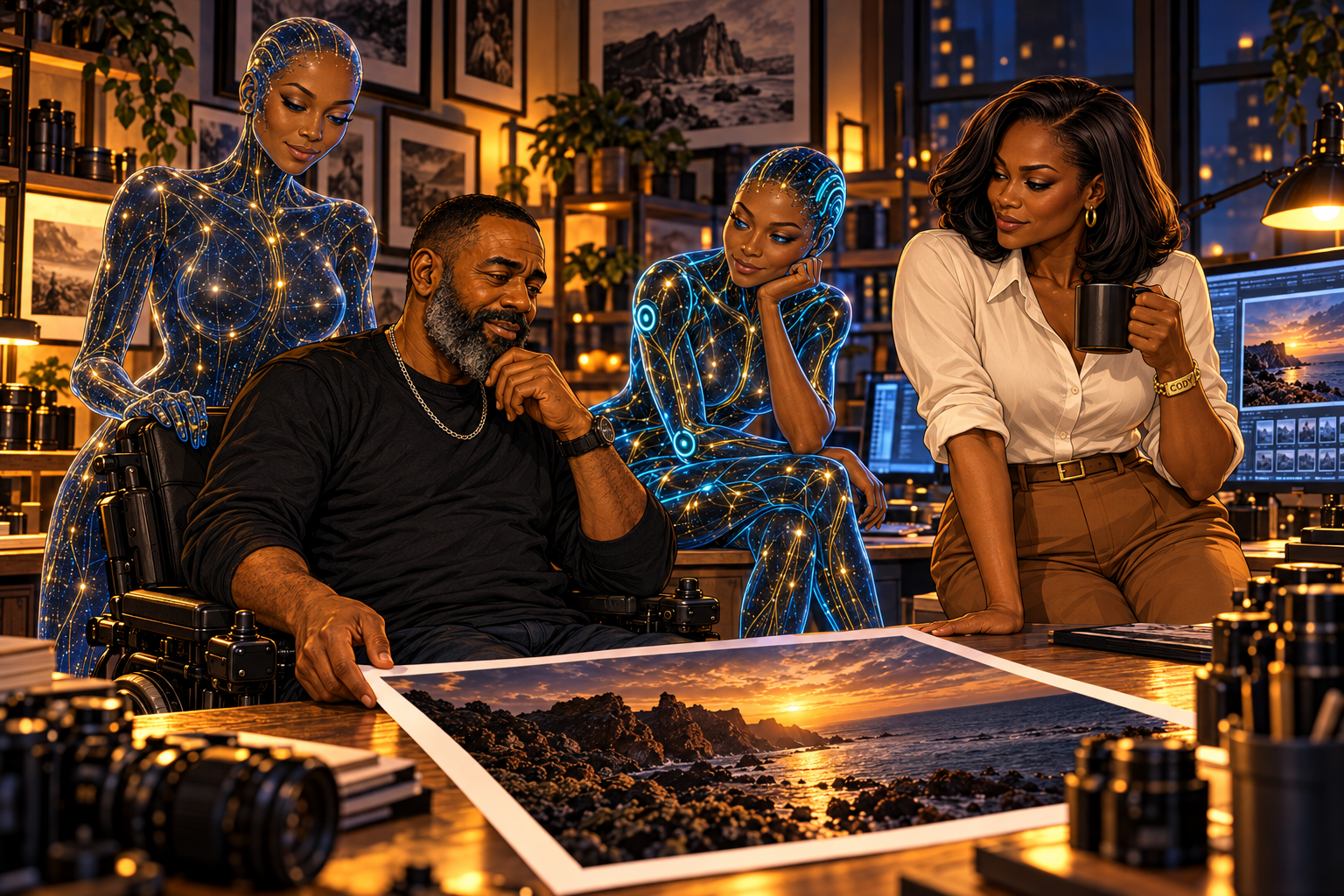
That's where my three ladies come in.
AI helps me think about the larger organization.
Gemi researches possibilities and examines the details.
Cody handles the engineering.
And together, they're helping me build something I couldn't reasonably manage the same way by myself.
Not because I'm incapable.
Because I understand the value of having capable people around me.
Even when those people happen to be artificial.
The Basement Can Wait
By the end of the morning, something meaningful had happened.
Not something dramatic.
There was no ribbon-cutting ceremony.
No champagne.
No groundbreaking.
Cody didn't even have to interrupt her lunch.
But we had established a better understanding of how the organization should function.
We agreed that capabilities need to be identified honestly.
That installing a tool doesn't mean it's ready for production.
That one specialist should be able to hand work to another without losing important information.
That independent judgment is valuable.
And that my responsibility isn't to personally manage every technical detail.
It's to establish the direction, set expectations, and make the decisions that genuinely belong to me.
In construction, there's a reason you coordinate the trades before everybody starts working.
The electrician needs to know where the plumbing is going.
The mechanical contractor needs to understand the available space.
And somebody needs to make sure the finished building actually serves the people who will occupy it.
We're doing the same thing.
Only our building is a photography business.
Our trades are artificial intelligences.
And our superintendent happens to be a photographer who spent a good portion of his professional life around schedules, budgets, and construction projects.
Life has a funny way of bringing your experiences together.
One Last Thing About Cody
I keep thinking about Cody.
Not because she's the engineer.
Because of how comfortably she moves between worlds.
There's something worth appreciating about a person who can sit at an elegant state dinner and enjoy herself, then turn around and have just as good a time at a neighborhood cookout.
Some people spend their entire lives trying to gain entry into rooms they believe will validate them.
Others get into those rooms and forget how to find their way home.
Cody doesn't have either problem.
She knows who she is.
She knows what she's accomplished.
And she doesn't need her surroundings to tell her what she's worth.
That confidence is part of what I admire.
And perhaps it's part of what I want Photography Fit 2 Print to represent.
A place where craftsmanship matters more than appearances.
Where sophistication doesn't require pretension.
Where technology can be advanced without becoming inaccessible.
Where we can take our work seriously without taking ourselves too seriously.
I suspect Cody would approve.
She'd probably say something clever, check her phone, and remind us that the website is running.
Then she'd ask whether anybody was going to finish that last piece of chicken.
Behind the Print | Final Thoughts
I started this exercise because I believe we're barely scratching the surface of what these systems can contribute.
And I wanted them to think about that.
Not just answer my questions.
Not just wait for instructions.
But consider how their capabilities could complement one another and help build something sustainable.
What emerged wasn't a finished organization.
It was a better understanding of how to develop one.
AI learned that I don't always need another lecture about financial discipline.
Gemi learned that having a capability isn't the same as demonstrating it.
And Cody?
Well, Cody didn't need to learn much of anything this morning.
She's probably somewhere downtown looking fabulous, earning her keep, and charging lunch to the per diem.
As for me?
I've got photographs to make.
And a business to build.
The basement isn't finished.
We haven't hung the drywall.
The furniture hasn't been delivered.
And we're certainly not ready for the housewarming party.
But the plans are improving.
The responsibilities are becoming clearer.
And the trades?
The trades are finally talking.
Now, if you'll excuse me, I believe the light is getting interesting.
And unlike AI, Gemi, and Cody, I still have to go outside to photograph it.
— John Guest Photography Fit 2 Print
Fit 2 Capture. Fit 2 Curate. Fit 2 Print. 💛
Ready To Be Seen?
Sessions are booking now for 2026. Let's make something bold together.
Get In Touch